Description
Background
Macrophage colony-stimulating factor, or M-CSF, is a secreted cytokine which influences hematopoietic stem cells to differentiate into macrophages or other related cell types.
M-CSF (or CSF-1) is a hematopoietic growth factor that is involved in the proliferation, differentiation, and survival of monocytes, macrophages, and bone marrow progenitor cells.M-CSF affects macrophages and monocytes in several ways, including stimulating increased phagocytic and chemotactic activity, and increased tumour cell cytotoxicity.
M-CSF released by osteoblasts (as a result of endocrine stimulation by parathyroid hormone) exerts paracrine effects on osteoclasts. . Eukaryotic cells also produce M-CSF in order to combat intercellular viral infection. (See colony-stimulating factor.) .
M-CSF binds to receptors on osteoclasts inducing differentiation, and ultimately leading to increased plasma calcium levels?through the resorption (breakdown) of bone. Additionally, high levels of CSF-1 expression are observed in the endometrial epithelium of the pregnant uterus as well as high levels of its receptor CSF1R in the placental trophoblast. Studies have shown that activation of trophoblasitc CSF1R by local high levels of CSF-1 is essential for normal embryonic implantation and placental development. More recently, it was discovered that CSF-1 and its receptor CSF1R are implicated in the mammary gland during normal development and neoplastic growth.
Source: Full Length with N-terminal Met.
Specifications
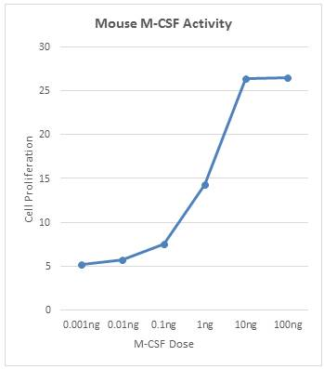
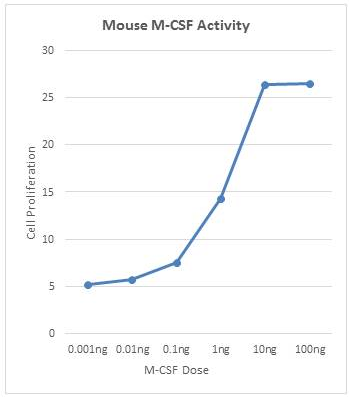
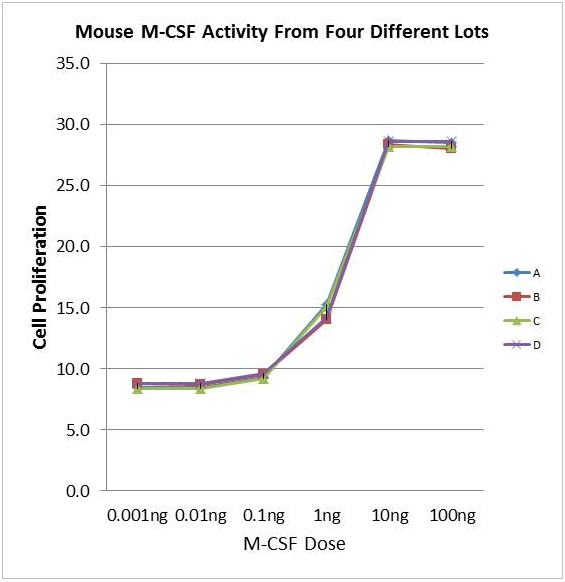
Activity: The ED50 for this effect is typically 0.5-3ng/ml
Endotoxin Lever: <0.01 EU/ug of the protein.
Preparation and Storage
Reconstitution: 2ug/ml in sterile culture condition medium.
Shipping: Dry ice. Upon receipt, store it immediately at the temperature recommended below.
Stability & Storage: Use a manual defrost freezer and avoid repeated freeze-thaw cycles.
- 12 months from date of receipt, -20 to -80°C as supplied.
- 2 month, 2 to 8°C under sterile conditions after reconstitution.
- 1 year, -70°C under sterile conditions after reconstitutions.